
14 Biological and Geological Coevolution
Billions of years ago the Earth was a very different place. Life seems to have emerged almost as soon as conditions were favorable after the planet had cooled and the environment allowed for the prebiotic chemistry to happen. As life proliferated, it had a profound effect on our planet affecting the environment, climate, and composition of our atmosphere while leaving behind a fossil record of its presence. In this chapter, we will explore the development of life and what evidence we have for how these changes occurred across geologic time.
Learning Objectives
By the end of this chapter, you will be able to:
- Discuss the evidence for where and when the first life on Earth may have arisen
- Describe hydrothermal vent communities
- Explain how oxygen became a key component of the Earth’s atmosphere and life processes.
- Describe the different geological timeframes and how they relate to the development of life on Earth
- Describe the five major mass extinction events in Earth’s history
Where did life arise on Earth?
It is unclear whether the transition from chemistry to biology occurred on the land surface of Earth or in the oceans. Those intermediate species on our planets – entities that are more than chemistry, but less than life – no longer seem to exist.
In the mid-1960s, Alexander Graham Cairns-Smith proposed that complex prebiotic molecules may have first organized around the regular crystal patterns found in minerals in clay. Cairns-Smith hypothesized that electrostatic forces in mineral crystals would help to concentrate and align specific molecules to their surface. With the help of this clay, precursors of RNA could have assembled, triggering the start of an RNA world. Tide pools have also been proposed as the site where chemistry developed the complexity needed for life. The cycles of evaporation and subsequent addition of water in tide pools might have concentrated the organic materials necessary to form life. Higher concentrations increase the likelihood that these organic materials will react and form RNA or lipids.
It is possible that, far from the rocky surface of Earth, life originated deep in the oceans when our planet was a frozen world. During the phases where Earth was covered by a thick mantle of ice, the ice may have protected organic compounds beneath the ice from the damage of impacting asteroids or ultraviolet radiation from the sun.
Deep-sea hydrothermal vents are hot spots that release gas from the Earth’s interior. DNA sequencing suggests that LUCA was a thermophilic microbe and deep sea vents might have been ideal locations for nurturing that early life. At first glance, this seems an inhospitable place for life. These vents are located in some of the darkest, highest pressure environments on our world. However, the gas that is released from hydrothermal vents creates a natural chemical gradient that can be used by living cells to generate the energy needed for metabolism. In deep hydrothermal vents, this chemical gradient flows around the rocks surrounding the vent and creates nooks where organic compounds can collect and reach higher concentrations. Minerals that are capable of acting as catalysts have been found in deep sea vents. Therefore, hydrothermal vents seem to provide the needed ingredients: high concentrations of organic compounds, natural catalysts, and a powerful energy source in the absence of sunlight. Today, extremely varied ecosystems are found around these vents.

When did life arise on Earth?
The evidence for timing the initial rise of life on our planet is ambiguous. The most ancient evidence has been destroyed as the first forms of life would have been single-celled organisms that did not leave behind fossil remains. However, suggestive evidence from biology, chemistry, and geology supports estimates that life arose on Earth between 3 to 4 billion years ago. Since the Earth formed about 4.56 billion years ago, the early appearance of life hints that the evolution from chemistry to life may be statistically probable. If so, this greatly increases the odds that life has also evolved elsewhere.
Carbon isotopes
The earliest line of evidence for timing the rise of life comes from carbon isotopes. Carbon naturally occurs in three isotopes, always with 6 protons, but with either 6, 7, or 8 neutrons, which are annotated 12C, 13C, and 14C respectively. The superscripts indicate the atomic mass number, or the total number of protons and neutrons in an element. Of these isotopes, 14C will undergo radioactive decay with a half life of 5730 years. However, 12C and 13C do not decay and therefore, the ratio of 12C to 13C is constant over time on the Earth. However, life preferentially incorporates the lighter 12C, rejecting 13C. Therefore, a low ratio of 13C to 12C offers a tentative suggestion that organic material existed and that isotopic imbalance can be incorporated into the metamorphic structure of the rock.
Why does life prefer to use 12C? While the chemical reactivity of an atom is predominantly driven by the electron configuration, more massive isotopes tend to have slightly slower reaction rates. That slight edge in the speed of reaction rates is enough of an advantage to favor the uptake of carbon-12 over carbon-13 in organic biochemistry.
Zircon crystals are commonly used to assess ages in very ancient geological records because they are very durable minerals, resistant to both heat and corrosion. Trapped minerals can be preserved when zircons form. A group of scientists from the University of California, Los Angeles studied 10,000 zircons gathered from western Australia. Of these ten thousand zircons, one contained a graphite inclusion, a compound composed entirely of carbon atoms.

Radiometric dating showed that this zircon crystal was 4.1 Gyr old and the carbon inclusion exhibited a larger ratio of 12C to 13C. Was this the chemical stain of primordial life, dating back to 4.1 Gya? On Earth today, this would be a good indicator of organic material. But, interpreting this result from so long ago is more controversial.
Stromatolites
Ancient stromatolites offer a more secure timeline for the emergence of life. These fossilized structures are found in shallow waters and look like modern structures formed by cyanobacteria. The oldest stromatolites have been found in South Africa and Australia and date back to the early Archean Period between 3.2 – 3.5 Gya. By the end of the Archean and throughout the Proterozoic geological periods, stromatolites appear to have been abundant and formed the first reefs.

Stromatolites today are composed of layers of microbial mats of photosynthesizing cyanobacteria, as shown in the YouTube video below. Photosynthesis depletes carbon dioxide in the water, precipitating calcium carbonate deposits, which along with other sandy sediments, is trapped in the sticky bacterial film. The bacterial colonies grow upward towards better exposure to the sun, and over time the layers of bacterial film and mineral precipitates build up to form distinctive layered stromatolites. Similar stromatolite structures are formed today.
Video credit: @jamief94086
We guess that ancient stromatolites were formed through biological processes, since we observe this behavior in microbes today. The processes required to make these structures seem to require microbes that are already quite complex and capable of photosynthesis. Actual first life then, likely to be a more primitive organism, would have existed even earlier than these ~3.5 Gyr old structures.
Microfossils
The most direct evidence for life comes in the form of microfossils, fossils preserving micro-organisms that may have been among the first living creatures on Earth. The most convincing microfossils date back to approximately 3 billion years ago. However, these are difficult to identify both because rocks undergo erosion over time and because the structures that resemble microfossils might actually be formed by nonbiological processes. Many supposed microfossils turn out to be false positives after careful chemical analysis. Though the discovery of a microfossil is an unmistakable mark of life, it is easy to be fooled. The Figure below gives you a good idea of the scant information content in microfossils.

The Age of Life
Evolution and Extinction
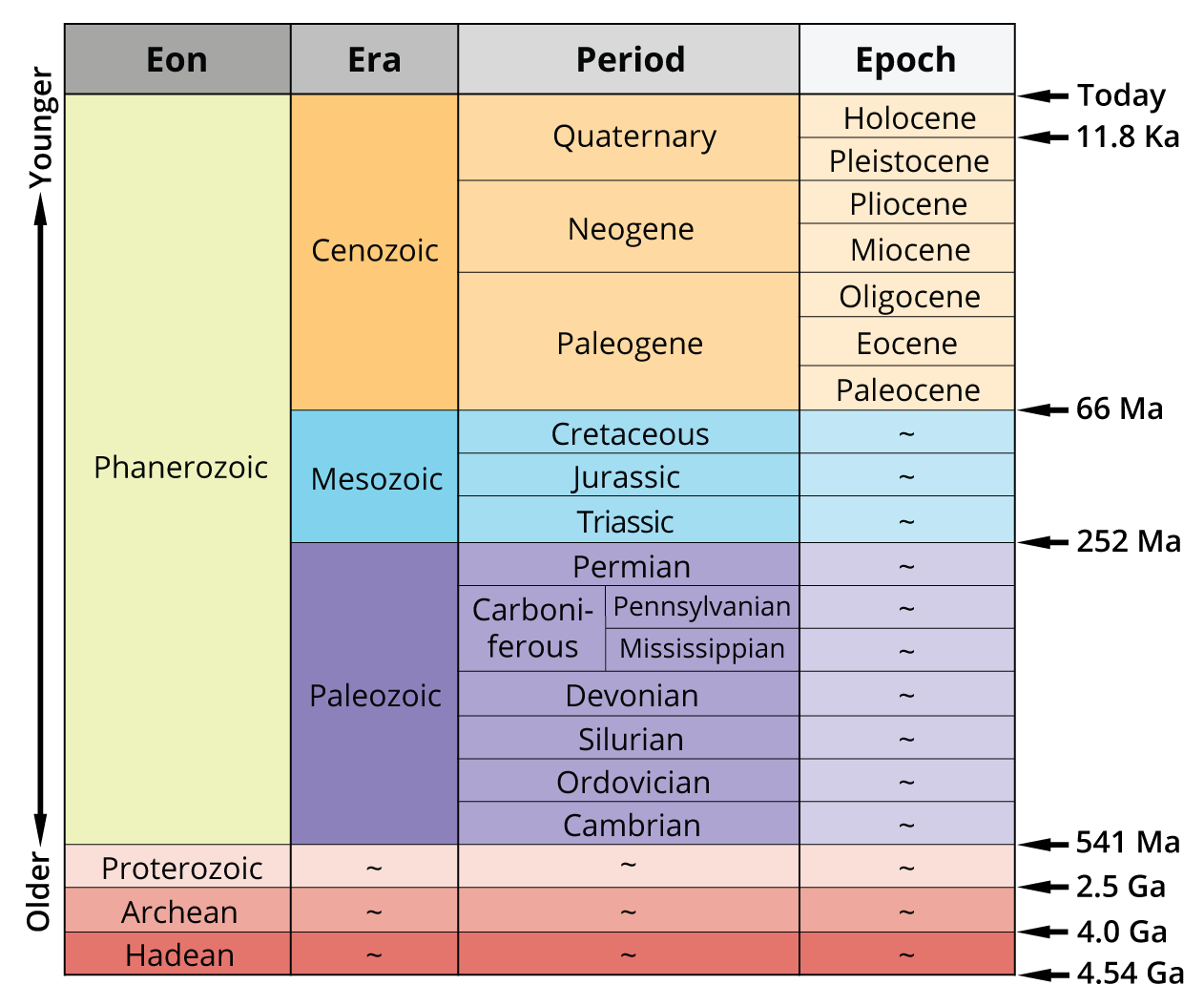
On geological time scales, time is organized into eons, eras, and periods. There are four main eons subdivided into different eras. The eras are in turn split into different periods. The current eon, the Phanerozoic Eon (541 Mya through today), is known as “The Age of Life.” The Cambrian Period is the earliest period of the Phanerozoic eon, lasting from 540 to 500 Mya. The events leading up to this period set the stage for an explosion of complex life. Changing atmospheric oxygen concentration allowed for more efficient aerobic metabolism and increasingly complex life forms.
The transitions between different geologic periods are defined by changes in the fossil record with many of the most dramatic changes occurring during mass extinction events, defined as a period of time when the rate of species going extinct is increasing with respect to the rate at which new species arise. Throughout the Phanerozoic era, there were 15 documented major extinction events. Five of these were major mass extinction events where more than half of all species on Earth at the time were lost. While mass extinctions are devastating, they do serve to encourage diversity. Had the dinosaurs not been eliminated 65 Mya, there may never have been such a successful emergence of mammals. The frequency of life in the Universe is a function of how often it arises, how often it survives, and how long it endures after evolving. In this way, the frequency and intensity of mass extinctions control the frequency of life.
Precambrian Life
The Proterozoic Eon began 2.5 billion years ago and set the stage for Phanerozoic life. From the geologic record, we know that oxygen levels were low before the Proterozoic. Therefore, microbes from the start of this era would have primarily been anaerobic chemotrophs, producing energy through chemical pathways.
Want to know more: Metabolic Lifestyles
Organisms can be identified according to the source of carbon they use for metabolism as well as their energy source. The prefixes auto- (“self”) and hetero- (“other”) refer to the origins of the carbon sources various organisms can use. Organisms that convert inorganic carbon dioxide (CO2) into organic carbon compounds are autotrophs. Plants and cyanobacteria are well-known examples of autotrophs. Conversely, heterotrophs rely on more complex organic carbon compounds as nutrients; these are provided to them initially by autotrophs. Many organisms, ranging from humans to many prokaryotes, including the well-studied Escherichia coli, are heterotrophic. All pathogens are heterotrophic because their carbon source is their host.
Organisms can also be identified by the energy source they use. All energy is derived from the transfer of electrons, but the source of electrons differs between various types of organisms. The prefixes photo- (“light”) and chemo- (“chemical”) refer to the energy sources that various organisms use. Those that get their energy for electron transfer from light are phototrophs, whereas chemotrophs obtain energy for electron transfer by breaking chemical bonds. There are two types of chemotrophs: organotrophs and lithotrophs. Organotrophs, including humans, fungi, and many prokaryotes, are chemotrophs that obtain energy from organic compounds. Lithotrophs (“litho” means “rock”) are chemotrophs that get energy from inorganic compounds, including hydrogen sulfide (H2S) and reduced iron. Lithotrophy is unique to the microbial world.
The strategies used to obtain both carbon and energy can be combined for the classification of organisms according to nutritional type. Most organisms are chemoheterotrophs because they use organic molecules as both their electron and carbon sources. Table 1 below summarizes this and the other classifications.
| Classifications | Energy Source | Carbon Source | Examples | |
|---|---|---|---|---|
| Chemotrophs | Chemoautotrophs | Chemical | Inorganic | Hydrogen-, sulfur-, iron-, nitrogen-, and carbon monoxide-oxidizing bacteria |
| Chemoheterotrophs | Chemical | Organic compounds | All animals, most fungi, protozoa, and bacteria | |
| Phototrophs | Photoautotrophs | Light | Inorganic | All plants, algae, cyanobacteria, and green and purple sulfur bacteria |
| Photoheterotrophs | Light | Organic compounds | Green and purple nonsulfur bacteria, heliobacteria | |
Source: LibreTexts Biology
The Proterozoic Eon was likely a time of rapid diversification of life. Today, there are systems of proteins that run checks during the replication of DNA to minimize transcription errors. However, these types of proteins are less common in prokaryotic microbes, which were common during the Proterozoic Era. A higher rate of mutations would have accelerated natural selection and driven a greater diversification of organisms. One of those mutations enabled photosynthesis, a more efficient process of respiration that produces oxygen as a byproduct.
The Rise of Oxygen
The rise of oxygen likely began with organisms known as cyanobacteria, an early type of photosynthetic bacteria thought to be the first organism to produce oxygen as a byproduct. Photosynthesis is the process by which organisms can harness the energy of the sun to generate energy for their own use. Cyanobacteria are the only known prokaryotes to produce oxygen, and this adaptation brought about the destruction of many other organisms.
Want to know more: Oxidation Reactions and the Free Radicals
Oxidation describes a chemical process in which a molecule, atom, or ion loses an electron. Oxygen is a particularly good oxidizing agent because its nucleus strongly attracts electrons to fill its valence shell. Oxidation often produces free radicals, which are very reactive. They can attack and break apart bonds in other molecules, inciting a chain reaction that is damaging for biochemical reactions.
Antioxidants are compounds that inhibit oxidation and thereby prevent the formation of free radicals. Plants and animals have many natural antioxidant systems in place to guard against this or use antioxidant vitamins such as vitamin A, vitamin C, and vitamin E. A certain amount of antioxidants is required in a well-balanced diet. However, clinical studies have been unable to prove benefits of artificially increasing antioxidant intake or antioxidant supplements.
The rise in atmospheric oxygen was far from smooth and steady (see Figure 6 below). Cyanobacteria slowly became more abundant, but there was still a significant delay in the build up of oxygen. There are several processes that would have hindered the rise in oxygen. Oxygen would have reacted with various chemicals, mainly iron, in the oceans, and these reactions would trap oxygen, prevent it from building up the atmosphere. Once it was able to escape the ocean, oxygen also reacted with rocks. The result is that it took about two billion years for atmospheric oxygen to rise to a level similar to today.

Oxygen may also have been taken up by microbes in metabolic pathways that generate energy. Organisms that used the oxygen to oxidize ammonia appear to have been plentiful at the time and could have been effective in the reduction of free-floating oxygen. Other organisms produced methane as a byproduct that could have acted as a sink for atmospheric oxygen. However, organisms that are known to produce methane require nickel to carry out the necessary reactions, and concentrations of nickel were dropping. The decrease of nickel would mean less excreted methane, and would allow oxygen to begin accumulating.
The increase of oxygen in the atmosphere was poisonous for anaerobic organisms. Most life was anaerobic, so the rise of atmospheric oxygen surely resulted in one of the most significant extinction events in Earth’s history. The fossil record shows a mass extinction of anaerobic life around 2.4-1.6 billion years ago, coincident with the rise of aerobic life.
Anaerobic vs Aerobic Life
The rise of atmospheric oxygen coincided with the appearance of far more complicated life forms. There is every reason to believe that the rise in oxygen would have been responsible since aerobic metabolisms are more efficient.
Respiration, in biological terms, describes the process by which organisms convert nutrients into usable energy by forming ATP bonds. Respiration begins with glycolysis, wherein glucose, a sugar, is broken down to form two molecules of a compound called pyruvate along with two molecules of ATP. Without oxygen, organisms have no choice but to undergo anaerobic respiration, or fermentation. Anaerobic respiration of yeast is what makes bread rise and beer bubbly. In this scenario, pyruvate is shuttled down a pathway which produces just two molecules of ATP.
Side Note: A byproduct of anaerobic respiration is a molecule called lactic acid. Lactic acid should be very familiar to any athlete or any student who has been very late to class and had to make a run for it. When our bodies overexert themselves, we begin to use up more oxygen than we can take in. In order to produce the energy needed to keep running, the body switches to anaerobic respiration, which leads to a build up of lactic acid. Lactic acid can damage muscle cells and hinder recovery. The process of producing this lactate is also the cause of next-day muscle soreness.
In the presence of oxygen, aerobic respiration becomes possible. With the help of oxygen, pyruvate can be broken down and enters a more complicated pathway known as the Krebs cycle or the citric acid cycle (note that organisms exhibit an enormous variety of metabolic pathways; the citric acid cycle merely represents one of the more common and well understood pathways). Through the citric acid cycle, organisms can produce from 30–36 ATP from just one molecule of glucose. Though more complicated to assemble, and therefore likely taking longer to evolve, this process can be up to 18-fold more efficient than anaerobic respiration. With more energy, it is possible to carry out more biochemical processes. This may have allowed cells to become increasingly complex and trend towards the more varied, multicellular life we see today. The rise of oxygen therefore enabled an explosion of complex multi-cellular organisms that appeared at the start of the Cambrian geologic era.
The Cambrian Explosion
At the time of the Cambrian explosion, there was an exponential increase in the number and complexity of organisms. Complex organisms likely preferred living in the oceans at first, where there was easy mobility and easy access to nutrients. Even very shallow levels of water provide protection from damaging UV radiation.
The earliest evidence of complex, land-based life comes from early land plants that begin to appear in the fossil record around 475 Mya. DNA evidence suggests that these plants evolved from algae, a general term for aquatic, photosynthetic organisms. It is a likely transition given that many breeds of algae prefer growing in shallow water to begin with. Algae adapted protections, such as thicker cell wells in order to survive dry spells, that would have been beneficial in the transition from water to land.

With other organisms still constrained to the water, land plants flourished and grew large in size. The lack of competition further allowed for increasing complexity: the development of root systems and tubes to transport water and nutrients throughout the plant. Photosynthesizing land-based plants had abundant energy from the Sun.
The Carboniferous Period
Forests began to cover the lands and dead organic matter began to pile up and decompose among the plants. Millions of years later, this organic matter would be compressed into coal, earning this period the name “carboniferous,” which means “coal carrying” in Latin.
The Carboniferous period began roughly 360 Mya and lasted about 60 million years. It was marked by an era of giantism. The fossil record from early in this period is rich in ocean and fresh water organisms. Land-based organisms appeared in the middle to later part of the period. The first terrestrial organisms were supersized insects and amphibians. By the middle of the Carboniferous period, adult amphibians were up to 6 meters long and developed the scaly skin typical of lizards by the end of the period. The Arthropleura, which resembles a 2.6-meter long millipede, proliferated during the late Carboniferous period and remains the largest-known land invertebrate ever discovered.
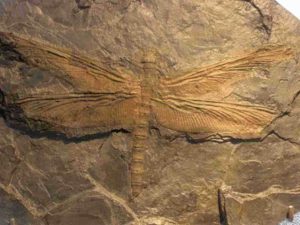
The Carboniferous period also gave rise to the largest-known flying insect: the Bolsover dragonfly. The Bolsover dragonfly looks nearly identical to the dragonflies common today, but with a wingspan of 30 cm – six times larger than a modern dragonfly. With a wingspan this large, the Bolsover dragonfly would not be able to fly in today’s atmosphere, with 21% oxygen. This has been used to suggest that atmospheric oxygen levels may have been as high as 30% during the Carboniferous period. Increased levels of oxygen as well as a generally moister environment would explain the large size of organisms at the time. Respiration was likely more efficient so that organisms could produce more energy and sustain their larger sizes.
As life continued to evolve and diversify, ecosystems began to resemble the types of settings we are familiar with today. This penchant for giantism continued into the Mesozoic era, which spanned from 252 to 66 Mya and is known as “the Age of the Dinosaurs.” The Cenozoic era that followed saw the emergence of mammals. The end of each period during the Phanerozoic Eon was marked by mass extinction events that completely upended the biological landscape of the time.
Mass Extinctions
Though organisms change and evolve, the most dramatic changes occur during mass extinction events, defined as a period of time when the rate of species going extinct is increasing with respect to the rate at which new species arise. Throughout the Phanerozoic era, there were 15 documented major extinction events. Five of these were major mass extinction events where more than half of all species on Earth at the time were lost.
Mass extinctions can be either gradual or sudden. The process of extinction follows five different phases:
- First is the extinction phase, which features a rapid decrease in biotic diversity.
- The second phase is the survival phase. Diversity is at a minimum here, but there is little further extinction. Organisms that survive past the second phase are known as the holdover taxa.
- Third is the rebound phase. Diversity begins to slowly increase again as ecosystems recover from the extinction event. The term progenitor taxa is used to describe species that have survived and now provide the evolutionary seeds for future organisms.
- The fourth phase, the expansion phase, is marked by a rapid increase in diversity due to the evolution of new species. The increase in diversity is helped in part by the opportunities and voids left by the many species lost during the first phase.
- The last phase, a recovery interval, is marked by a long period of environmental stability as diversity continues to rise. Disaster taxa describe species that proliferate most successfully following an extinction event. They are typically small and simple, hardy rather than complex and therefore capable of surviving extinction events.
Evidence for extinction events come from sweeping changes in the fossil records at different geological changes. However, fossils provide an incomplete and often confused record of past life. Roughly one third of organisms feature calcified parts that could be turned into fossils. The erosion of sedimentary rock may also obscure how old a fossil really is. Our understanding of mass extinctions is therefore inversely proportional to their age (older events have less certain evidence), and is proportional to the extent of the extinction. Extinction events that caused a greater loss in diversity are easier to categorize.
While mass extinction events threaten the very presence of life on Earth, they also lead to enhanced evolutionary diversity. It is important to understand these ubiquitous pressures on life, as similar events are likely to occur on every planet. If life is easily and regularly eliminated through frequent extinction events, then it may make finding surviving life in the Universe much harder.
The Ordovician-Silurian (O-S) Extinction
The Ordovician-Silurian (O-S) extinction, which occurred 450-440 Mya, describes two events that together resulted in the loss of nearly 70% of the worlds species at the time, making this the second-largest mass extinction event. The extinction event had a global effect and particularly affected marine life, where it is estimated that nearly 85% of species were lost.
The event was most likely caused through sudden climate changes. The timeline matches up with a shift in the then super-continent, Gondwana, into the south pole. As Gondwana passed over the south pole, it began to form ice caps across its surface. This shift also exposed more land, causing a drop in CO2 levels through weathering and cooling the planet.The cooling of the Earth led to the formation of glaciers, which locked up waters from the ocean. This, in turn, caused sea levels to drop, exposing and destroying shallow-water habitats along continental shelves. Evidence for glaciation during this time period has been found in the Sahara Desert. The combination of glaciation and cooling is thought to be the main causes of the O-S extinction.
The event ended when volcanic out-gassing of greenhouse gases increased the atmospheric temperatures enough to melt the glaciers and stabilize sea levels. The rebound phase of the O-S extinction resulted in increased biodiversity on the re-flooded continental shelves. However, recovery species in the ocean and land plants of the time were initially less complex.
The Late Devonian Extinction
At least 70% of all species were also lost during the Late Devonian extinction, which lasted from 375-360 Mya. There is some evidence that this extinction event was actually a series of seven,distinct extinction pulses. As with the O-S extinction, marine life was particularly hard hit.
The Late Devonian extinction is thought to have been caused by changes in the sea level, triggered by global cooling combined with acidification and oxygen depletion in the oceans similar to the O-S extinction, changing sea levels, or oceanic volcanism.
The rapid evolution of more complex plants from 30 cm up to 30 m during this period likely contributed to the oxygen depletion in the ocean. The increase in plant mass required the development of extended root and vascular systems in plants. These roots would have stabilized increasingly deeper layers of soil, causing a change in the chemical composition of which nutrients were run off into rivers, lakes, and eventually the ocean. This effect could have decreased the amount of oxygen in the oceans as well as reduced CO2 levels, which would have contributed to global cooling.
Less oxygen in oceans also caused organic matter to be better preserved, preventing organisms from decomposing and recycling their nutrients. Instead, many organisms formed into oil, which was absorbed by the porous reef rocks common in the area. These oil deposits remain a major source of oil in America today.
The End Permian Extinction
The End Permian extinction (or Permian-Triassic or P-T extinction) occurred about 252 mya and is the single largest mass extinction event ever recorded. It is nicknamed the “The Great Dying.” Approximately 96% of all marine life was lost along with over 70% of land species, including everyone’s favorite prehistoric creature, the trilobite.

The cause of such a large extinction was most likely the final stages of the break up of Pangea. The shifting of continents caused molten rock to be exposed and increased volcanic activity, releasing volatile carbon, methane, and SO2. The effect is actually quite similar to that of burning fossil fuels today. The Earth began to heat up under this new blanket of greenhouse gasses; it is thought that the temperature of the entire ocean increased by 2°C.

Warm ocean water transported heat to the poles, which in turn began to melt and release more greenhouse gases that had been frozen before. As the amount of CO2 increased in the atmosphere, it likewise began to dissolve and accumulate in the oceans, causing oceans to acidify. Furthermore, the warmer ocean water was unable to hold as much oxygen. The combination of increasing acidity and decreasing oxygen likely gave rise to the grievous destruction of marine life during the P-T extinction.
The End Triassic Extinction
The End Triassic extinction occurred 200 Mya, with 70-75% of all species becoming extinct. Most of the large amphibians common at the time were eliminated, and dinosaurs were left with little competition, allowing them to flourish in the following Jurassic period.
The end Triassic extinction event was sudden, lasting less than 10,000 years. Many causes have been proposed, but none are definitive. Gradual climate change can explain some of the observed properties of the extinction. An asteroid impact could also explain some of the properties of the extinction, but a crater of the appropriate size and age has yet to be found. The extinction may also have been caused by an unlucky sequence of volcanic eruptions increasing the release of carbon dioxide and sulfur and triggering climate change. Increased amounts of volcanic compounds can be found in the rock layers from this period.
The Cretaceous-Paleogene (K-Pg) Extinction
The Cretaceous-Paleogene (K-Pg) extinction occurred 66 Mya, and 75% of species became extinct, including all land-bound dinosaurs. Dinosaur fossils are only ever present before this time in the rock records. The extinction had a surprisingly variable impact, with dinosaurs being greatly affected while mammals and birds survived to ultimately become the predominate life forms on the planet.
The rock record from this time exhibits an unusual amount of iridium with gold, osmium, and platinum. These elements are relatively rare on Earth, but are commonly found in meteorites. The amounts of these rare metals could have been contained in an asteroid that was 10-15 km in diameter. The energy from such an asteroid would be equivalent to the force of 100 million hydrogen bombs. Other evidence includes shocked quartz and spherical rock droplets, which require both high temperatures and great pressure to form. Widespread soot deposits also suggest enormous fires across land masses.
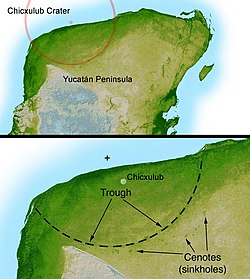
The Chicxulub crater, buried beneath the Yucatán Peninsula in Mexico has both the appropriate age and size that are expected of the asteroid that could have caused the devastation seen during the P-T extinction event. The crater stretches 150 km across and is approximately 20 km deep.
Extinctions and Life
While mass extinctions are devastating, they do serve to encourage diversity. Had the dinosaurs not been eliminated 65 Mya, there may never have been such a successful emergence of mammals. The frequency of life in the Universe is a function of how often it arises, how often it survives, and how long it endures after evolving. In this way, the frequency and intensity of mass extinctions control the frequency of life. On Earth, there have been 15 major mass extinctions in the last 500 million years. Five of those 15 eliminated more than half of all species on the planet.
Key Concepts and Summary
The deep oceans may have been one of the most stable environments on Earth, immune to the wild swings of conditions on the surface of the planet. This has led to speculation that the first life may have emerged in deep-sea thermal vents with strong chemical gradients to energize biochemistry. The evidence for life has been captured in the geologic record and unsurprisingly is more ambiguous the farther back in time we go. There is circumstantial evidence for life in the ratio of carbon isotopes in outcroppings of rocks and in zircon crystals that are about four billion years old. Fossilized layered structures date back to about 3.2 billion years ago and are reminiscent of stromatolite mats that are abundant today. Microfossils that are 2 – 3 billion years old and have structures that appear to be imprints of microbial life. The first atmospheric oxygen was produced by cyanobacteria, beginning about 2.7 billion years ago. The rise of oxygen took about 2 billion years, but enabled the development of more complex life, including that of the Cambrian explosion 540 million years ago. After this the geologic record becomes clear, recording the rise and fall of species at different spatial depths that correspond to different look-back times. This evolution is punctuated by five major mass extinction events, each of which eliminated more than half of all species on the planet.
